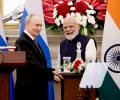
India and Russia have called for an uncompromising global fight against terrorism without hidden agendas and double standards. Prime Minister Narendra Modi asserted that the menace is a direct attack on the values of humanity.

India on Wednesday said the adoption of the Comprehensive Convention against International Terrorism would provide a legal base for a fight against the global scourge, noting that the United Nations' global counter-terrorism strategy would be incomplete without such a convention. In an address to the ongoing 66th session of the United Nations General Assembly, Rajya Sabha Deputy Chairman K Rahman Khan termed terrorism as a "scourge of humanity" and a global problem.

In a joint declaration issued after the 16th BRICS Summit in the Russian city of Kazan attended by Prime Minister Narendra Modi and Chinese President Xi Jinping, among others, the leaders reiterated unequivocal condemnation of terrorism in all its forms and manifestations while reaffirming that it should not be associated with any religion, nationality, civilisation or ethnic group.
"We call on Pakistan to stop cleansing their own minorities including Hindus, Christians, Sikhs, Buddhists and others," Bhat said.
Her statement comes ahead of Pakistan Prime Minister Shahid Khaqan Abbasi's address at the United Natiosn General Assembly.

Terrorism came under special focus by Dr Singh in his address to the 63rd session of the UN General Assembly. "It is vital that we strengthen international cooperation to combat terrorism and to bring the perpetrators, organisers, financiers and sponsors of terrorism to justice.
India will ask members of the United Nations to ensure a "zero tolerance" approach towards terrorism besides pressing for an early adoption of the Comprehensive Convention on International Terrorism during the United Nations General Assembly's annual gathering of world leaders.

Modi, who visited Cyprus in the first leg of his three-nation visit, reiterated India's support for Cyprus's unity and for a peaceful resolution of the Cyprus Question based on UN Security Council resolutions, international law, and the EU Acquis.

The BRICS nations condemned the Pahalgam terror attack, advocated for a zero-tolerance approach to terrorism, and criticized rising tariffs during their summit in Rio de Janeiro. They also addressed global challenges and called for reforms in international institutions.

Describing Central Asia as India's "extended neighbourhood", Doval said New Delhi accords "highest priority" to this region, adding Afghanistan is an important issue "concerning all of us".
India will make a strong pitch for comprehensive reform of the United Nations Security Council to create an equitable system that is reflective of current realities when Prime Minister Manmohan Singh addresses the UN General Assembly on Saturday.

We have nothing to gain by raising our concerns internationally as our narrative has got entangled with several controversial concepts in the United Nations, asserts Ambassador T N Sreenivasan.

In the document, the global body expressed concerns over the increasing use of Internet and other information and communications technologies, including social media platforms, for terrorist purposes.

The BRICS nations have expressed concern over the proliferation of trade-restrictive actions in the form of 'indiscriminate rising' of tariffs, particularly measures used as a means of 'coercion', cautioning that such practices risk marginalising the Global South countries.

"We are now living in an era when non-state military actors are a major factor," Narendra Modi said in a veiled reference to threats posed to India from Pakistan
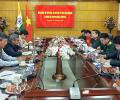
The 15th India-Vietnam Defence Dialogue signalled a move from routine talks to deeper cooperation, with new deals on submarine rescue and defence industry to support stability in the Indo-Pacific, notes Dr Rajaram Panda.

India has said the multiple terror attacks in Paris and Beirut highlight the urgent need to finalise a global convention on terrorism.
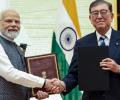
India and Japan have unveiled a comprehensive framework to boost their defence cooperation in response to security challenges, particularly concerning China's increasing military presence in the East and South China Seas.
Prime Minister Narendra Modi has acknowledged that the dreaded terror group Islamic State poses one of the greatest challenges facing the international community today and said there is a need to "delink terrorism from religion".
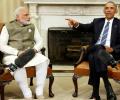
The American side also committed itself to treat Pathankot attack at par with 26/11 terror strike in terms of ensuring punishment to perpetrators based in Pakistan.
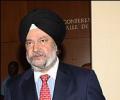
More than a decade after India launched a spirited campaign for a United Nations Comprehensive Convention on International Terrorism as well as reform of the UN Security Council, both in the permanent and non-permanent categories, there is renewed hope that both campaigns may succeed, thanks to India's untiring diplomatic efforts at the world body. Ambassador Hardeep Singh Puri.

India supports dialogue and diplomacy and not war, Prime Minister Narendra Modi said at the Brazil, Russia, India, China, South Africa (BRICS) Summit in Kazan, Russia on Wednesday, in an unambiguous message calling for resolution of the Russia-Ukraine conflict through peaceful negotiations.
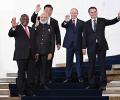
The territory of Afghanistan must not be used to carry out terror attacks against other countries, the five-nation influential grouping BRICS said on Thursday and strongly called for combating terrorism in all its forms and manifestations, including the cross-border movement of terrorists.
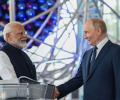
Prime Minister Narendra Modi on Tuesday told Russian President Vladimir Putin that a solution to the Ukraine conflict is not possible on the battlefield and peace efforts do not succeed in the midst of bombs and bullets even as he flagged concerns over a missile strike on a children's hospital in Kyiv.

Joshi said the international community must have a policy of zero tolerance towards terrorism and "towards those who aid and abet terrorist acts and provide safe havens to their perpetrators".

At the largest international stage -- the UN General Assembly-- External Affairs Minister Sushma Swaraj sent out a stern message to Pakistan Prime Minister Nawaz Sharif, saying, "Talks and terror cannot go together".

Sushma in her address at the Shanghai Cooperation Organisation Council of Foreign Ministers meeting said that terrorism is an enemy of basic human rights.

The declaration also names Pak-based terror groups like LeT and JeM.

In retrospect, it appeared that the bitterness of the war was still strong and the Ukrainian success in occupying Russian territory just a few days ago had added to the complexity of the situation. The positive US response to the visit, however, remains a silver lining in the dark clouds, notes Ambassador T P Sreenivasan.

The prime minister lamented on the lack of unanimity amongst the member states on the issue of terrorism, saying it dents those very principles, that are the basis for the creation of the United Nations.

It asked all nations to work together to expedite the adoption of the Comprehensive Convention on International Terrorism in the UN General Assembly without any further delay.
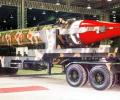
Ambassador Pankaj Sharma, Permanent Representative of India to the Conference on Disarmament (CD), Geneva, said India has been drawing the attention of the world towards these threats and the need to strengthen international cooperation to address them through its annual consensus UNGA resolution titled 'Measures to prevent terrorists from acquiring weapons of mass destruction'.

Indian Prime Minister Narendra Modi on Saturday addressed the UN General Assembly. Modi's 35-minute address covered a number of subjects such as terrorism, including its resurgence in West Asia, reforms of the United Nations, including the Security Council, and the need for a more inclusive global development.

Early reform of the United Nations Security Council, terrorism and peacekeeping will be among the main issues that India will pursue during the world body's General Assembly session, Indian ambassador to the UN has said.

Addressing the plenary session of the 11th Asia-Europe Meeting Summit here in the Mongolian capital, Vice President Hamid Ansari said, "all our societies today face unprecedented levels of threat from terrorism in all its manifestations. The most recent example is what has happened, most unfortunately in France."

''The avoidance of the 'P' word had less to do with reality and more to do with the politics -- domestic and international -- of Mr Modi and his efforts to both appear statesman-like (vis-a-vis Pakistan) and rid himself of the taint of being some kind of Muslim-baiting hardliner.'

The Quad also vowed to work towards a free, open and prosperous Indo-Pacific, a region that has seen increasing Chinese military muscle-flexing in the last few years.

In a joint statement released after talks between Prime Minister Narendra Modi and President Donald Trump, the two nations also called on Islamabad to "expeditiously bring to justice the perpetrators of the 26/11 Mumbai, Pathankot, and other cross-border terrorist attacks perpetrated by Pakistan-based groups."

Swaraj also said that Pak cannot take Kashmir to the ICJ.
 © 2026 Rediff.com - Advertise with us - Disclaimer - Privacy Policy - Sitemap - Feedback - About us - Terms of use - Grievances